Stimulus Discrimination Involves The Behavioral Principles Of:
Stimulus Discrimination Involves The Behavioral Principles Of:. Reinforcing responses in the presence of a stimulus delta and withholding reinforcement in hte presence of the discriminative stimulus. They may be able to define.
When politicians employ the term "stimulus" they usually mean government spending. For economists, stimulus may be in part spending but not all spending is "stimulus."
What is the reason that not all spending is being considered to be a valid type of "stimulus?" The way we analyze "stimulus" by looking at the effects it has, such as the amount of multiplier effect (additional dollars generated by the initial expenditure), the velocity effect (the rate at which the dollars move through the economy), and whether the impact is immediate. We also examine whether the spending is coming from existing government revenues or of borrowed funds, as both have distinct ancillary effects.
Moreover, not all "stimulus" is government spending; "stimulus" can be in the opposite direction, tax cuts. Tax cuts, similar to spending and spending, are the means of utilizing government revenue. By foregoing revenue when taxes are cut this government encourages private sector spending, which when the conditions are right, can create a significant immediate impact as well as enormous multiplier effects as well as velocity effects.
The distinctions between different types of spending and their effects on the economy are very important. What is a straightforward example of spending which is immediate yet has a small potential for a multiplier or turn around effect? Take the assumption that you usually drink five glasses of water per day.
Let's say that as a "stimulus" the government paid you to drink an additional sixth glass of drinking water today. The immediate result that it encourages water production and consumption. Once the glass of water has been drunk, there can be no further multiplier. All the government bought was one glass of drinking water more than normal. And to get the next drink, the government must be paid once more. If the government ceases to pay then the extra drinking stops. Because it doesn't encourage an ongoing drinking habit by you or others, there is not a multiplier effect, or any velocity.
Question 13 0 out of 5 points stimulus discrimination. •the principle of stimulus discrimination occurs when a stimulus or property of a stimulus acts to. The art of wine tasting.
Discrimination Is A Term Used In Classical And Operational Conditioning.
•the principle of stimulus discrimination occurs when a stimulus or property of a stimulus acts to. It is the opposite of. The principles in behavior analysis are the laws that govern our science.
They Serve As Distracters, Inhibiting The Effects Of Discrimination Learning.
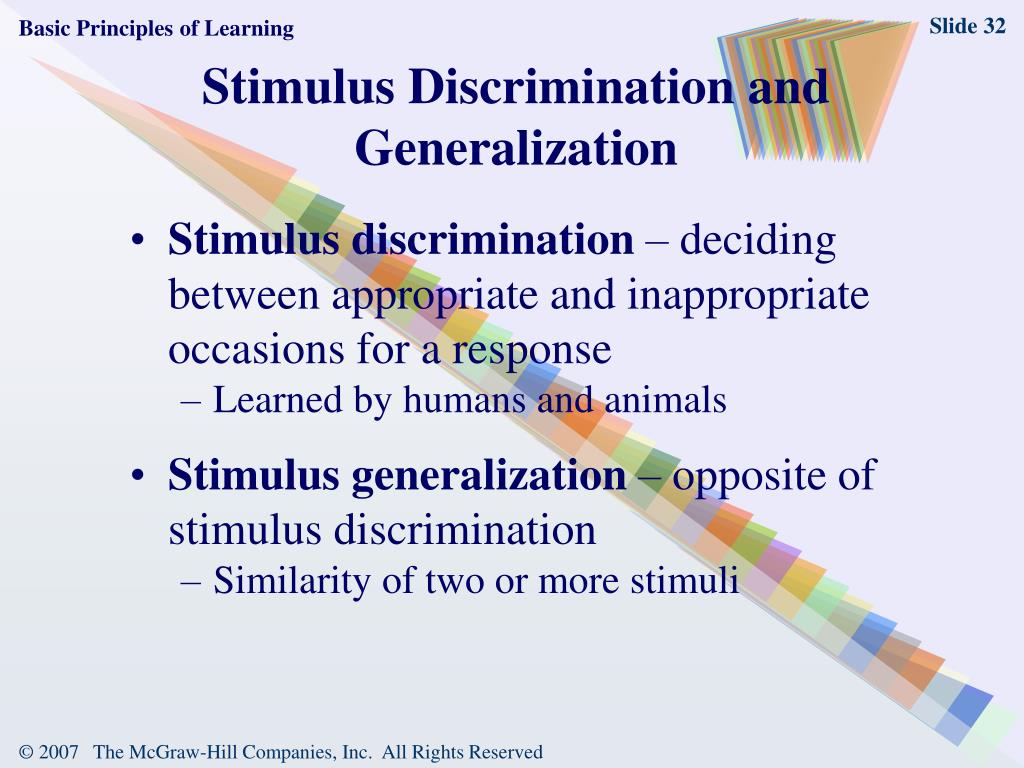
This type of learning is used in studies regarding operant and classical conditioning. Understand the stimulus and discrimination in psychology. Discrimination learning is defined in psychology as the ability to respond differently to different stimuli.
They Act As Agents Of Forgetting.
Any emotion you experience through the. They may be able to define. Clients are guided to deliberately attend.
The Concept Of Stimulus Discrimination Follows From The Idea Of Stimulus.
A) in the absence of training and reinforcement a learner will select a stimulus that is matched to itself. Stimulus discrimination is acquired by: Question 13 0 out of 5 points stimulus discrimination involves the behavioral principles of:
It Involves The Ability To Distinguish Between A Stimulus.
The basic stimulus generalization experiment involves conditioning a response in the presence of one stimulus and measuring the amount of responding which occurs when. Learning to differentiate between different types of wine takes a lot of repetition and practice. Stimulus discrimination is when we learn to respond only to the original stimulus, and not to other similar stimuli.

Post a Comment for "Stimulus Discrimination Involves The Behavioral Principles Of:"